
Sign In Start Free Trial
Account

Add to playlist

Create a Playlist

Modal Close icon
You need to login to use this feature.
  • Book Overview & Buying Learn PostgreSQL
  • Table Of Contents Toc
Learn PostgreSQL

Learn PostgreSQL

By : Luca Ferrari, Enrico Pirozzi
3.4 (5)
close
close
Learn PostgreSQL

Learn PostgreSQL

3.4 (5)
By: Luca Ferrari, Enrico Pirozzi

Overview of this book

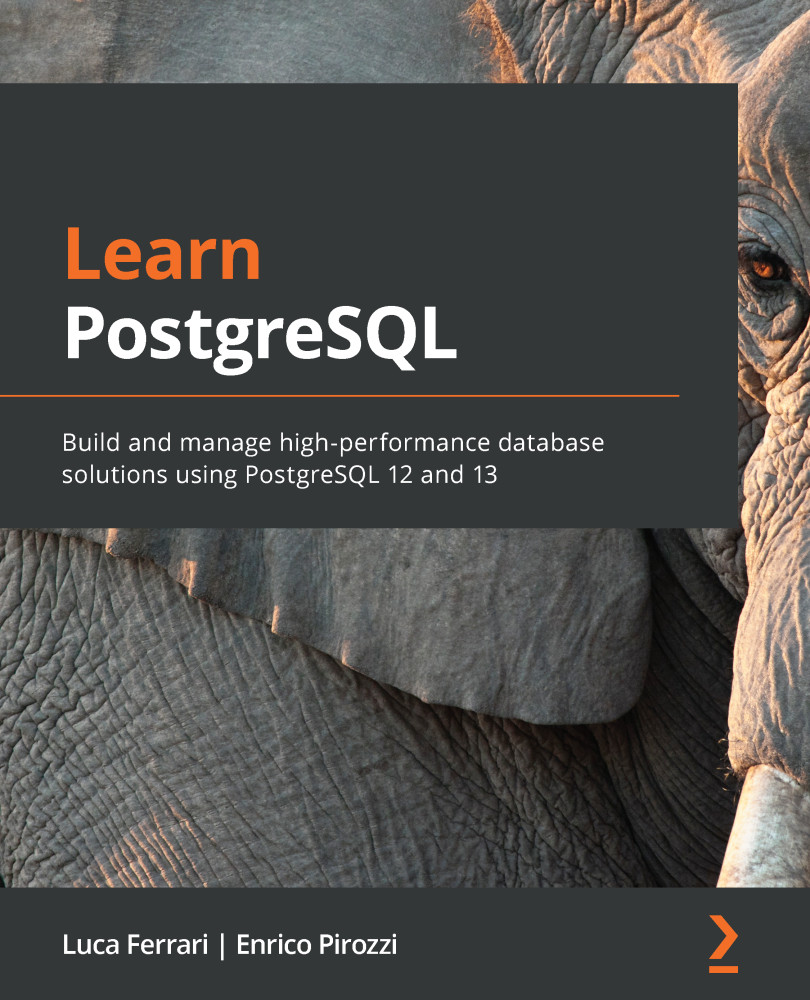
PostgreSQL is one of the fastest-growing open source object-relational database management systems (DBMS) in the world. As well as being easy to use, it’s scalable and highly efficient. In this book, you’ll explore PostgreSQL 12 and 13 and learn how to build database solutions using it. Complete with hands-on tutorials, this guide will teach you how to achieve the right database design required for a reliable environment. You'll learn how to install and configure a PostgreSQL server and even manage users and connections. The book then progresses to key concepts of relational databases, before taking you through the Data Definition Language (DDL) and commonly used DDL commands. To build on your skills, you’ll understand how to interact with the live cluster, create database objects, and use tools to connect to the live cluster. You’ll then get to grips with creating tables, building indexes, and designing your database schema. Later, you'll explore the Data Manipulation Language (DML) and server-side programming capabilities of PostgreSQL using PL/pgSQL, before learning how to monitor, test, and troubleshoot your database application to ensure high-performance and reliability. By the end of this book, you'll be well-versed with the Postgres database and be able to set up your own PostgreSQL instance and use it to build robust solutions.
Table of Contents (27 chapters)
close
close
1
Section 1: Getting Started
5
Section 2: Interacting with the Database
12
Section 3: Administering the Cluster
20
Section 4: Replication
23
Section 5: The PostegreSQL Ecosystem
Managing Users and Connections

PostgreSQL is a complex system that includes users, databases, and data. In order to be able to interact with a database in the cluster, you need to have at least one user. By default, when installing a new cluster, a single administrator user (named postgres) is created. While it is possible to handle all the connections, applications, and databases with that single administrative user, it is much better to create different users with different properties and privileges, as well as login credentials, for every specific task.

PostgreSQL provides a very rich user-management structure, and single users can be grouped into a variety of different groups at the same time. Moreover, groups can be nested within other groups, so that you can have a very accurate representation of your account model. Thanks to this accurate representation, and thanks to the...

CONTINUE READING
83
Tech Concepts
36
Programming languages
73
Tech Tools
Icon Unlimited access to the largest independent learning library in tech of over 8,000 expert-authored tech books and videos.
Icon Innovative learning tools, including AI book assistants, code context explainers, and text-to-speech.
Icon 50+ new titles added per month and exclusive early access to books as they are being written.
Learn PostgreSQL
notes
bookmark Notes and Bookmarks search Search in title playlist Add to playlist download Download options font-size Font size

Change the font size

margin-width Margin width

Change margin width

day-mode Day/Sepia/Night Modes

Change background colour

Close icon Search
Country selected

Close icon Your notes and bookmarks

Confirmation

Modal Close icon
claim successful

Buy this book with your credits?

Modal Close icon
Are you sure you want to buy this book with one of your credits?
Close
YES, BUY

Submit Your Feedback

Modal Close icon
Modal Close icon
Modal Close icon